Client project · Web3 Platform
Quick Sync
Building a privacy-first collaboration platform where sessions are ephemeral, encryption is the default, and no account is ever required.
3dApps in the Suite
At a glance
The engagement
- Client
- Quick Sync
- Industry
- Web3 Platform
- Engagement
- Product build
- Stack
- Next.js, React, TypeScript, Prisma
- Contribution
- Software engineering
- Status
- Shipped, in production
- 3dApps in the Suite
- ZeroAccounts Required
- E2EEncrypted by Default
- P2PWaku + WebRTC Delivery
Before
Project context
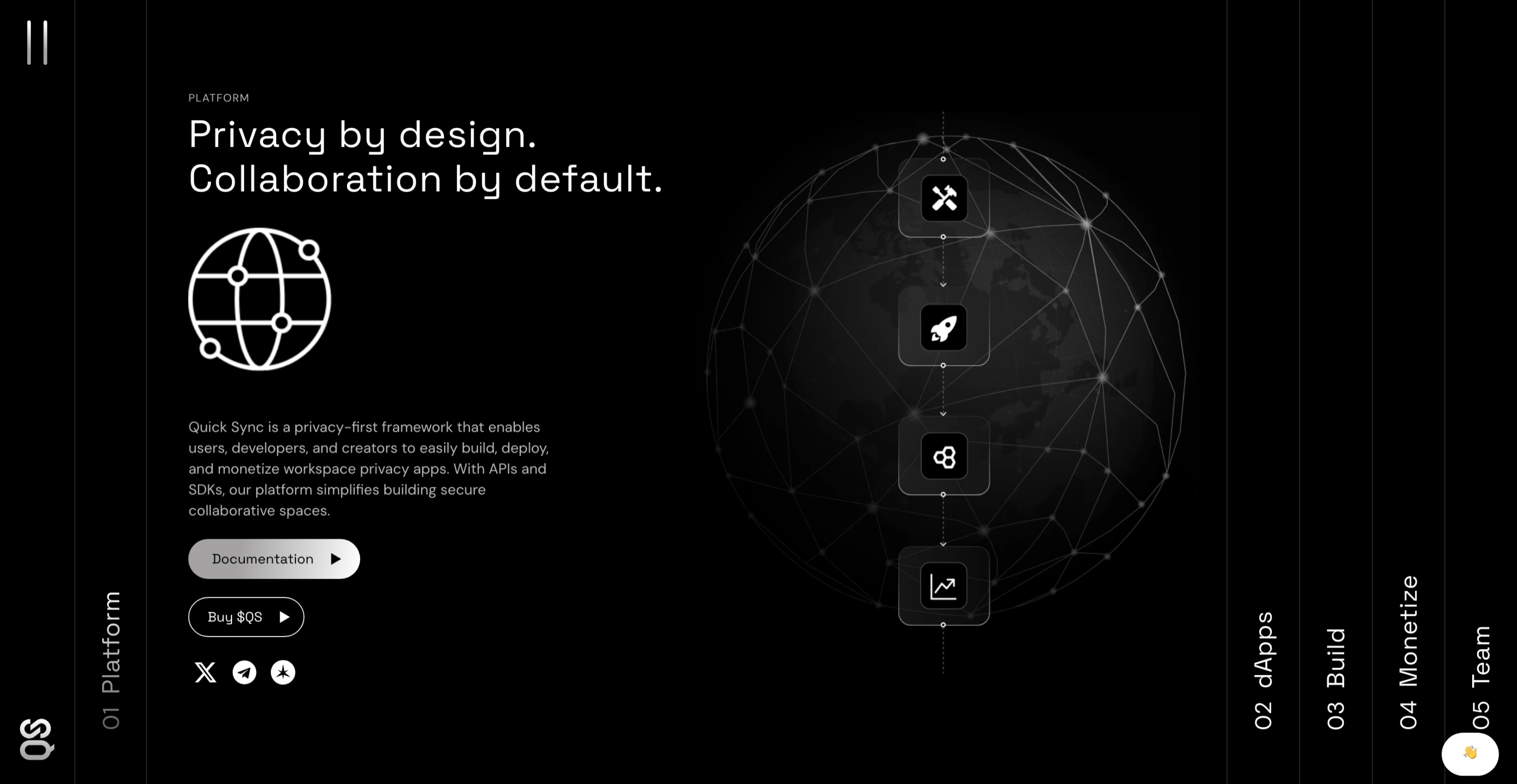
Quick Sync is a decentralized collaboration platform built on the principle that privacy is a right, not a privilege. Rather than bolting encryption onto a conventional SaaS product, the platform treats ephemeral sessions and end-to-end encryption as the default state — users share files, run live Q&A, and collaborate without creating an account, and without the platform ever holding readable data. ENGISOLS worked across the stack: responsive interfaces, secure API routes, database operations, and third-party integrations, contributing to the QS Share and StageX dApps alongside the marketplace and token layer.
Privacy had to be structural, not a setting — the interface needed to work with no account, no persistent storage, and no server-side access to user content.
Sessions are ephemeral by design, so the UI had to communicate expiring state and key exchange clearly without exposing users to cryptographic complexity.
Content delivery spans two very different paths — live peer-to-peer transfer and decentralized buckets for offline recipients — behind one consistent interface.
StageX required real-time anonymous Q&A with voting and moderation, where participation is untraceable but abuse still has to be controllable.
The marketplace and token layer needed wallet-connected flows to sit alongside the no-account path without fragmenting the product into two separate experiences.
What we built
A privacy-first decentralized collaboration platform — encrypted file sharing, anonymous live Q&A, and a developer framework for building privacy dApps.
Technical decisions
Engineering decisions
Front End — Next.js + TypeScript
Responsive, animation-led interfaces built in TypeScript, covering the platform surface and both flagship dApps. The design language leans on motion to make invisible cryptographic state legible — session lifecycles, key establishment, and expiry are surfaced as interface feedback rather than technical detail the user has to interpret.
API Layer — Secure Server Routes
Secure API routes handling the operations that cannot run client-side, deliberately scoped so encrypted payloads pass through without the server holding keys or readable content. External service integrations sit behind this layer rather than being called directly from the client.
Data — Prisma-Backed Persistence
Database operations through Prisma for the metadata the platform legitimately needs — channel lifecycles, marketplace listings, and dApp records — kept strictly separate from user content, which never lands in a readable form.
dApps — QS Share and StageX
QS Share delivers ephemeral, end-to-end encrypted file sharing across invitation-only, link-based, and public access modes. StageX brings real-time anonymous Q&A to live sessions and X Spaces, with community voting and moderation tooling that works without identifying participants.
Monetization — Marketplace + Token
Interface work for the QS Marketplace, where developers list privacy dApps, and the $QS token integration underpinning creator monetization and on-chain revenue sharing.
Stack
- Next.js
- React
- TypeScript
- Prisma
- PostgreSQL
- Node.js
- WebRTC
- Web3
Results
What changed
- Three privacy dApps shipped on a shared framework — QS Share and StageX live, FileXchange in development.
- Full platform functionality reachable with no account and no wallet, keeping the privacy promise intact at the entry point.
- A single interface spanning both peer-to-peer and decentralized-bucket delivery, so users never have to reason about transport.
- Framework surface documented and opened to external developers, with APIs and SDKs supporting third-party privacy apps.